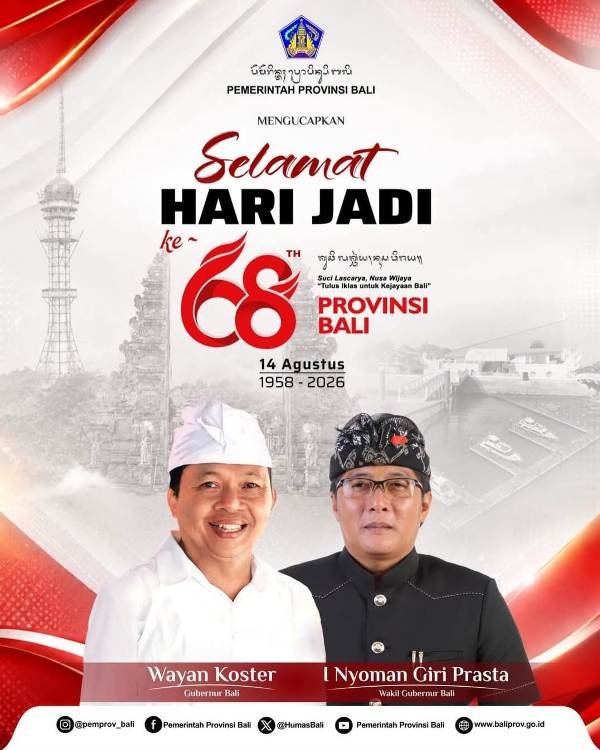




Denpasar, Eyewitness – Made Hiroki, a young entrepreneur from Bali and a driving force behind PT Solusi Aksara Lestari, has demonstrated his serious commitment to finding solutions for the waste crisis on the “Island of the Gods.” Moving beyond mere ideas and promises, Made Hiroki has introduced a waste-processing machine based on pyrolysis technology, now ready for a live demonstration and testing. He has invited the Governor of Bali, Wayan Koster, to witness, inspect, and evaluate the machine’s capabilities firsthand.
Amidst the persistent, unresolved waste issue, Made Hiroki aims to prove that the innovation offered by his company is more than just talk. Through PT Solusi Aksara Lestari, he hopes the technology will be given the chance to undergo open testing, allowing the government to gain a direct understanding of both its capabilities and its limitations.
“We aren’t just all talk! We haven’t come bearing empty promises; we’ve brought the actual machine—tangible proof!” asserted Made Hiroki.
According to him, Bali’s waste problem demands concrete action and the courage to introduce innovation. While many ideas regarding waste-processing technologies have been proposed, what truly matters is whether these technologies can be validated through real, measurable, and accountable testing.
For this reason, Made Hiroki hopes the Governor of Bali can set aside time to visit the testing site.
“To the honorable Governor of Bali, we aren’t asking you to take our word for it. We are simply requesting one opportunity: come, see, and test our machine for yourself!” he said.
He emphasized that this invitation is not merely a promotional effort for his company’s product, but rather a gesture of transparency, welcoming the government to examine the full scope of the technology’s capabilities. His team is also fully open to having the testing process involve government technical teams, academics, environmental experts, or independent institutions. “If our machine is truly capable of helping to address Bali’s waste problem, let us prove it together. Should there be any shortcomings, we are open to evaluation and improvement. We are not afraid of being tested, because our goal is to find a real solution for Bali,” he said.
The innovation by Solusi Aksara did not emerge overnight. Previously, Made Hiroki had introduced the design for this waste-processing technology in April 2026. The development of the machine subsequently progressed through assembly, the refinement of components, and the testing of a demonstration unit.
On May 3, 2026, the technology from Solusi Aksara was presented to the Deputy Regent of Tabanan and the Head of the Tabanan Regency Environmental Agency. At that time, the closed-system pyrolysis technology was proposed as an alternative for reducing waste accumulation—specifically the residual waste that has long burdened final disposal sites.
In the developer’s initial presentation, the “Solusi Aksara” system was described as a closed-loop processing unit that utilizes heating in an oxygen-free environment. This concept employs pyrolysis technology—reportedly originating from Japan—which has been adapted to meet the specific waste management needs of Indonesia.
On June 13, 2026, Made Hiroki announced that the demonstration unit for the Solusi Aksara machine had been completed and was entering its final refinement stage. Intensive testing is currently underway to ensure that every component functions optimally before the system moves to field operations.
Made Hiroki has now reiterated his readiness to showcase the machine through live trials. He emphasizes that the development process should not conclude with assembly and design presentations, but rather progress to a practical demonstration of its operational capabilities.
A key point of interest regarding the Solusi Aksara technology is the processing capacity claimed by the developers.
According to the design specifications previously introduced, the machine is said to be capable of processing approximately 50 to 100 tons of waste within a six-hour period. This figure represents the capacity stated by the developers and remains to be verified through operational testing and independent measurement.
The system is designed to operate at temperatures ranging from approximately 400 to 700 degrees Celsius, utilizing carbon dioxide (CO?) and nitrogen (N?) within a closed, oxygen-free processing environment.
Unlike open-air incineration, pyrolysis is a process that decomposes materials through heating under conditions with minimal or no oxygen. Depending on the characteristics of the raw material and the specific operating conditions, this process can yield gases, condensed liquids, and solid residues.
The Solusi Aksara design also incorporates a multi-layered filtration system—consisting of cyclones, scrubbers, and carbon filters—to manage the gases generated during the process.
The final output is claimed to be a ceramic-like ash, which has the potential to be used as a raw material for manufacturing paving blocks. The developers further state that the process is designed to minimize residue and significantly reduce the overall volume of waste. However, all these specifications must be verified through testing—covering mass balance, the quality of processed output, residue characteristics, energy consumption, and emission measurements—under actual operational conditions.
Made Hiroki stated that his team is open to an evaluation of all these aspects.
The technology offered by Solusi Aksara comes at a time when Bali continues to face significant challenges in waste management.
According to the 2025–2029 *RPJMD Semesta Berencana* (Comprehensive Regional Medium-Term Development Plan) for the Province of Bali, waste generation in Bali reached 1,313,092.47 tons in 2024—an average of approximately 3,597 tons per day. This figure represents an increase from the 980,087.37 tons recorded in 2020. In other words, over a four-year period, waste generation in Bali has grown by approximately 34 percent. The RPJMD (Medium-Term Regional Development Plan) data also indicates that waste generation in Bali increased from 1,046,616.04 tons in 2021 to 1,112,356.84 tons in 2022 and 1,229,234.65 tons in 2023, reaching 1,313,092.47 tons in 2024.
Meanwhile, waste reduction was recorded at 149,019.99 tons in 2020, followed by 162,475.48 tons in 2021, 151,149.66 tons in 2022, 178,706.82 tons in 2023, and 212,773.34 tons in 2024.
Regarding waste management (handling), the volume was recorded at 561,318.15 tons in 2020, increasing to 620,729.29 tons in 2021 and 714,061.12 tons in 2022. In 2023, the figure reached 754,868.92 tons, but it subsequently fell to 707,886.12 tons in 2024.
The data shows that waste generation continues to rise, while the volume of waste being managed in 2024 has actually decreased compared to the previous year.
The percentage of managed waste in Bali has also seen a decline. After reaching 77.78 percent in 2022, the figure dropped to 75.95 percent in 2023 and 70.07 percent in 2024.
This situation indicates that increasing waste management capacity has become an urgent necessity. Waste reduction at the source, waste sorting, organic waste processing, the utilization of recyclables, and the management of residual waste must all be implemented concurrently.
The issue of waste has gained increased attention following the government’s decision to impose restrictions on waste disposal at the Suwung landfill, effective April 1, 2026.
On April 7, 2026, the Ministry of Environment/Environmental Management Agency clarified that the Suwung landfill would no longer accept organic waste and would be reserved exclusively for residual waste.
This policy is part of a broader shift in the waste management system—moving away from the traditional “collect, transport, and dispose” model toward a system focused on waste reduction and processing at the source.
This situation requires both local governments and the public to strengthen waste processing facilities. Relying solely on landfills is no longer sufficient; a system capable of reducing the volume of waste before it reaches the landfill is essential.
On the other hand, the government has also begun to focus on utilizing technologies that convert waste into energy or products with economic value.
On October 3, 2026, the Minister of Environment/Head of the Environmental Management Agency (BPLH), Moh Jumhur Hidayat, visited the Gema Santi TOSS Center in Klungkung Regency. During the visit, the government observed firsthand the application of pyrolysis technology, which processes waste into alternative fuel for industrial use.
The central government also expressed its readiness to facilitate connections between energy products derived from local waste processing and industries in need of such resources.
This development indicates that pyrolysis technology is emerging as a viable alternative for waste management in Bali. Nevertheless, as each technology possesses distinct characteristics, capacities, output types, and environmental requirements, they must be evaluated based on the results of individual testing.
While opportunities for utilizing such technologies are opening up, environmental considerations remain a critical requirement.
I Made Rentin, an Expert Staff to the Governor of Bali for Human Development, Culture, and Social Affairs, previously emphasized that any waste-processing innovation—including pyrolysis technology—must comply with environmental regulations and licensing requirements.
In a report dated September 26, 2026, Rentin highlighted two essential criteria that must be met: emission test results that align with the standards set by the Ministry of Environment, and the fulfillment of all necessary permits and environmental management protocols.
These requirements are vital to ensure that any introduced technology not only effectively processes waste but also avoids creating new pollution issues.
According to Made Hiroki, this should also be an integral part of the validation process for “Solusi Aksara.”
He stated that he welcomes a comprehensive government assessment—covering everything from the actual capacity of the machinery and energy requirements to system safety, emission quality, and the characteristics of any residual waste produced.
In his view, independent testing will provide clarity regarding both the capabilities and the limitations of the technology. At the national level, the government has issued Presidential Regulation Number 109 of 2025 concerning the Management of Urban Waste through the Conversion of Waste into Renewable Energy using Environmentally Friendly Technology.
This regulation provides a policy framework for the development of technologies that convert waste into renewable energy—including electricity, bioenergy, renewable liquid fuels, and other by-products.
However, the existence of this regulation does not mean that any given waste-processing machine automatically meets the requirements for implementation. Technical aspects, feasibility, environmental impact, and licensing must still be examined in accordance with applicable regulations.
In this context, Made Hiroki hopes that Solusi Aksara will be given an equal opportunity to undergo objective examination and evaluation.
He advocates for the government, academics, environmental agencies, and independent parties to witness the testing process firsthand. This ensures that claims are not based merely on corporate promotion, but rather that the machine’s full capabilities are verified through data and formal assessment results.
According to him, addressing the waste problem in Bali requires collaboration among various stakeholders. The government holds the authority and sets policy, academics provide research capacity, and the business sector contributes technological innovation and investment.
“We don’t want to get caught up in debates over who is ‘most correct’ or who is ‘most capable’ of providing a solution. We want to show what we have already accomplished. Please, come, examine, and evaluate it. If there is anything that needs improvement, we are ready to make those adjustments,” he stated.
He also emphasized that the involvement of private companies in waste management should not be viewed solely from a business perspective. In his view, any innovation must deliver tangible benefits to the public and contribute positively to the environment.
“I am a son of Bali. I want Bali to be clean. I refuse to just stand by and watch while our island struggles with a waste crisis!” he asserted.
Made Hiroki hopes that the invitation extended to the Governor of Bali will serve as the starting point for more concrete communication and collaboration between the local government and developers of waste-to-energy technology. “We have already taken the first steps. We have brought the technology, and we are ready to prove its effectiveness. Now, we are requesting an opportunity for the Bali government to evaluate it firsthand,” he concluded.
For Made Hiroki, the issue of waste is not merely a matter of machinery or technology. More importantly, it requires a collective commitment to implement solutions that can be tested, applied, and held accountable.
“We want a clean Bali. This is not just about machines; it is about the future of Bali,” he added.