

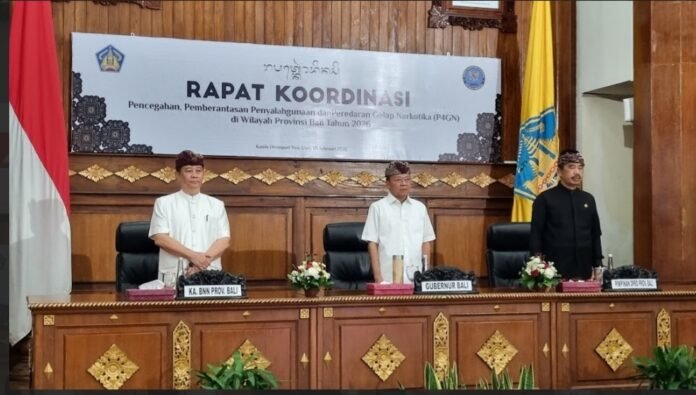
Head of the Bali Province National Narcotics Agency; Brigadier General Pol. Drs Budi Sajidin. M. Si Conveyed the strategy carried out by BNN with a collaborative and humanitarian-oriented approach including synergy between government and society and other stakeholders, an integrated approach with prevention and eradication efforts with central synergy and implementation in the regions so that responses are more effective and sustainable. As well as a strategy that is no less important in the BNN slogan which is popular among the public, “War On Drugs For Humanity”, handling drugs by prioritizing a balance between state firmness and human values in the basic principles of national policy. As well as Hard Power’s attitude towards drug syndicates with a firm and tough attitude through strong and consistent law enforcement. And the last one is Soft Power for drug victims and users, with a recovery and rehabilitation approach as well as protecting human rights and dignity.
The threat of drugs in Indonesia continues to grow every year. In 2025, it was recorded that 4.1 million people of productive age were exposed to drugs. This condition shows that the threat of drugs continues to grow and reaches all areas in urban and rural areas. The island of Bali is especially an area that is prone to becoming a route for illicit narcotics trafficking involving cross-provincial and international networks.
BNNP Bali has also mapped the drug danger zone area in Denpasar City as an example; in the villages of Sesetan, Pemogan and Pemecutan Kelod. Meanwhile, the highest number of drug cases in Bali was in the Denpasar area with 571 cases, Badung 114 cases, Buleleng 98 cases, Tavanan 49 cases, Gianyar 42 cases, Jembrana 39 cases, Karangasem 29 cases, Klungkung 27 cases, Bangli 24 cases.
From a social and tourism perspective, the phenomenon of drug abuse in Bali as a foreign tourism area can pose a serious threat to the security and social values of the Balinese people.
Apart from that, the development of new types of drugs is increasingly widespread with threat patterns that are increasingly complex and difficult to detect through substances such as Etomidate in vape fluid and Clandestine Labs. This shows that the threat of drugs continues to transform, so cooperation between officer resources and adequate facilities is needed so that cooperation and collaboration are more progressive and comprehensive.
Another challenge is limited access to rehabilitation services which only exist in Bangli and Badung. As well as the lack of stakeholder participation in preventing the dangers of drugs which are a common enemy that threatens the resilience of the Indonesian nation, in accordance with Law number 35 of 2009 concerning narcotics.
By : Daniel Herry