

Jakarta, Eyewitness | The Iranian armed forces have attacked the location of American E-3 Sentry (AWACS) long-range radar detection aircraft and tankers at Israel’s Ben Gurion Airport, as well as a US radar detection facility and electronic warfare facilities in the United Arab Emirates (UAE). This was reported on April 1 by the Iranian Fars news agency.
“In this wave of attacks, powerful Arash-2 drones with a range of 2,000 km were used,” the agency said in a Telegram channel message.
It was previously reported that Iran also targeted several KC-135 tanker aircraft at Prince Sultan Air Base in Saudi Arabia.
On Friday, an Iranian missile and drones reportedly hit the Prince Sultan Air Base in Saudi Arabia, according to a report by The Wall Street Journal (WSJ). The airbase, about 96km (60 miles) southeast of the Saudi capital, Riyadh, is run by the Saudi air force but is also used by US forces.
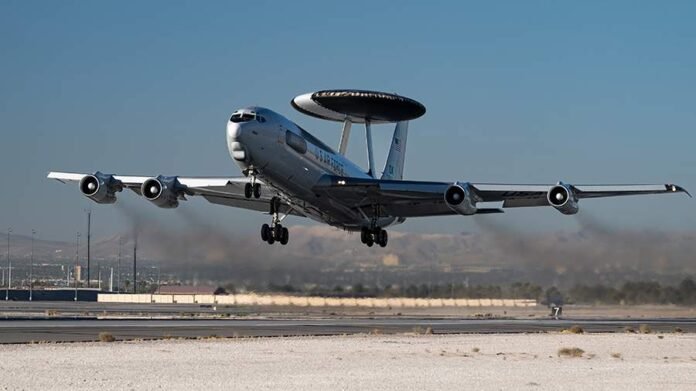
The attack damaged multiple KC-135 tankers, which refuel US aircraft in flight, and an E-3 Sentry airborne warning and control system (AWACS) aircraft, Air & Space Forces Magazine, a publication that covers US air defence and national security issues, reported on Saturday.
At least 15 American soldiers were wounded and five were in serious condition, The Associated Press news agency reported, quoting unnamed sources briefed on the strikes.
Neither the US military nor Saudi Arabia has commented on the incident. Al Jazeera could not independently verify the reports.
The destruction of a US Air Force E-3 Sentry aircraft in an Iranian strike on a Saudi Arabia air base could damage US abilities to spot incoming Iranian threats at distance, analysts say.
Dramatic images of the wrecked aircraft, geolocated by CNN, show its tail broken off and its distinct rotating radar dome –– a critical part of the airborne warning and control system, or AWACS –– on the ground at the Prince Sultan Air Base.
The loss of the AWACS is “a serious blow to (US) surveillance capabilities,” said CNN military analyst Cedric Leighton, a former US Air Force colonel who has flown on the aircraft.
“It can potentially impact (US) ability to control combat aircraft and vector them to their targets or protect them from engagements of hostile aircraft and missile systems,” he said.
CNN has reached out to US Central Command for comment on the destruction of the aircraft.
The AWACS enables airborne monitoring of up to 120,000 square miles of battlespace from the ground to the stratosphere, and it has been a vital component of US fighting forces for decades. The fleet of 17 E-3s, and America’s experience using them over the years, is seen by analysts as a major advantage enjoyed by Washington.
Images of the destroyed aircraft began appearing on social media sites over the weekend. CNN geolocated the images to the air base in central Saudi Arabia by comparing them to a satellite image from March 11, which showed the E-3 aircraft at the same location in the recent photos.
CNN had previously reported that an attack on the air base left at least 10 US service members injured. No fatalities were reported. A US Air Force tanker aircraft was also damaged, sources said.
The E-3 aircraft itself is a powerful airborne command post as well as a surveillance platform.
It can track around 600 targets at one time, from other aircraft, to missiles, to large drones, even down to tanks on the battlefield.
Personnel aboard the E-3 can pass that info down to commanders in theater, to ships at sea or back to the Pentagon in real time.
Meanwhile, controllers aboard the AWACS can direct interceptor fighter jets to incoming threats or send attack aircraft to support ground troops under fire.
A report this month from the Center for a New American Security calls the AWACS the “quarterback” of the battlefield, “nimbly providing critical situational awareness and real-time coordination that turns individual sorties into a dominant force.”
The report calls AWACS “an indispensable asset for US military operations today and for the foreseeable future.”