



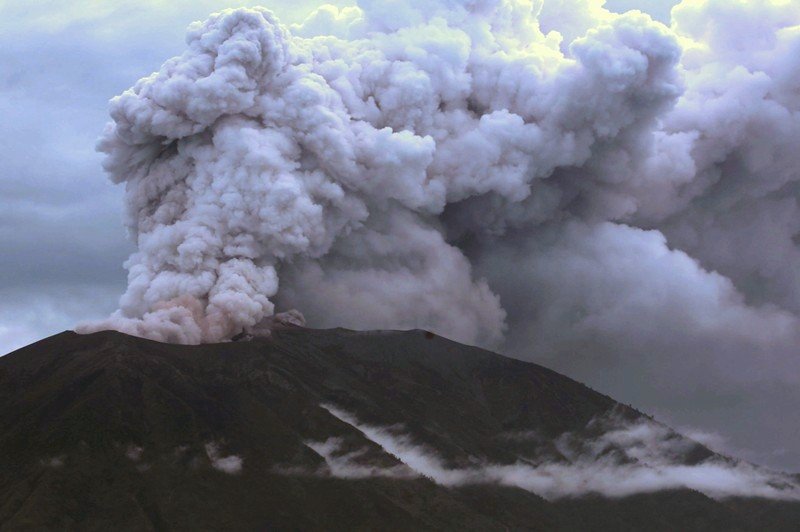
Manado, Eyewitness | Residents of Tomohon City, North Sulawesi (Sulut), are urged to be aware of the potential dangers of Mount Lokon, located in the local area. The current threat from Mount Lokon’s activity is the possibility of toxic gas escaping from the crater at any time.
This was conveyed by the Acting Head of the Geological Agency, Lana Saria, in a report on Mount Lokon’s activity received in Manado on Saturday, April 18, 2026. “Residents also need to be alert for sudden phreatic eruptions (eruptions caused by the contact of hot magma vapor with hydrothermal waters),” she said.
The activity report for the period March 16-31, 2026, stated that residents living near river channels originating from the summit of Mount Lokon should be aware of the possibility of lahars during the rainy season or prolonged heavy rainfall at the summit.
Mount Lokon’s seismic activity during the period from March 16 to 31, 2026, recorded 42 eruption earthquakes and one non-harmonic tremor. Furthermore, there were 43 shallow volcanic earthquakes, seven deep volcanic earthquakes, three local tectonic earthquakes, and 61 distant tectonic earthquakes.
Based on visual observations of Mount Lokon’s activity, thin white plumes of smoke were observed with a maximum height of approximately 25 meters above the crater. Mount Lokon’s seismicity during this period was dominated by shallow volcanic earthquakes (VB), while deep volcanic earthquakes (VA) were rarely recorded.
Several recommendations must be adhered to by the public, visitors, tourists, and climbers. These include prohibiting activities and approaching areas within a 1.5-kilometer radius of the Tompaluan crater (the center of activity) of Mount Lokon.
In the event of an eruption and ashfall, the public is advised to remain indoors. When outdoors, it is recommended to wear nose, mouth, and eye protection (goggles).
Furthermore, be aware of the potential for lahars in rivers originating from the summit of Mount Lokon, especially during the rainy season.