



Eyewitness – DENPASAR
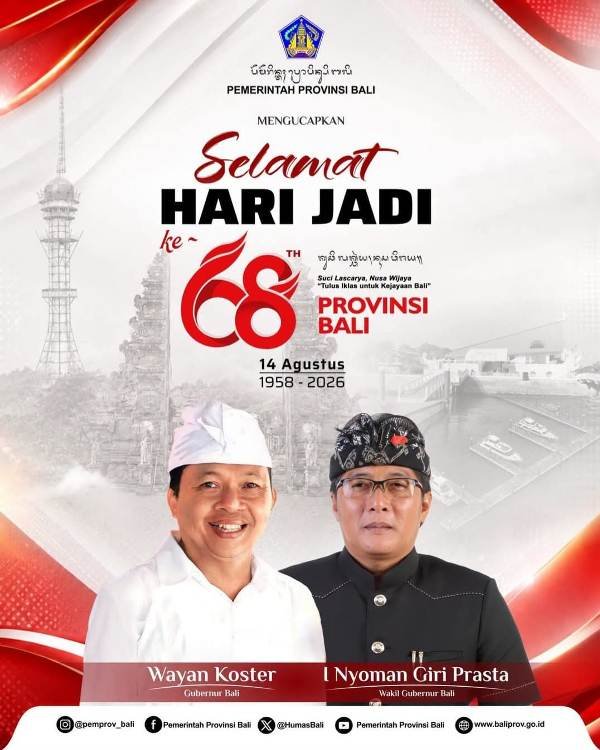
The Governor of Bali, Wayan Koster, accompanied by Deputy Governor I Nyoman Giri Prasta, officially inaugurated the 8th annual Bung Karno Month 2026 on Monday, June 1, 2026. The opening ceremony took place at the Ardha Candra Open Stage, Art Center, Denpasar.
The commencement of the 2026 Bung Karno Month was marked by the striking of the Bende, a traditional Balinese ceremonial gong. The high-profile event was attended by Ida Shri Bhagawan Putra Nata Nawa Wangsa Pamayun, Speaker of the Bali Regional Legislative Council (DPRD) Dewa Made Mahayadnya, regents and vice-regents from across the province, Mrs. Seniasih Giri Prasta, and members of the Bali Provincial Forkopimda (Regional Leadership Coordination Forum). Also in attendance were the Regional Secretary of Bali Province Dewa Made Indra, municipal leaders, heads of regional government agencies (OPD), and thousands of local residents.

In his keynote address, Governor Koster stated that the 2026 Bung Karno Month, themed “Kawya Atma Kerthi”—meaning ‘Celebrating the Revolutionary Spirit of the Proclamator’—is being held in an atmosphere filled with profound nationalistic, cultural, and spiritual fervor.
Koster emphasized that Bung Karno Month is far from a mere annual ceremonial agenda. Instead, it serves as an ideological and cultural catalyst to reignite the revolutionary fire of Indonesia’s founding father within the collective consciousness.
The theme “Kawya Atma Kerthi” carries profound philosophical weight. ““Kawya” represents the noble expression of the soul, “Atma” is the essence of the deepest consciousness, and “Kerthi” signifies the effort toward purification and glorification,” Koster explained. “Therefore, this theme calls upon us not only to remember Bung Karno as a historical figure, but to channel his revolutionary spirit as a living energy in our daily thoughts, attitudes, and actions.”
Koster noted that Bali remains a province consistent in organizing Bung Karno Month. According to the two-term governor, the month-long commemoration provides a spiritual space to nurture the nation’s collective memory.

“Bung Karno did not just bequeath us independence; he left behind a legacy of souls brave enough to dream big, think ahead of their time, and act solely for the well-being of the people,” Koster said.
He added that history remembers how Bung Karno’s revolutionary path was forged through oppression, imprisonment, and exile. Yet, it was precisely from those limitations that the grand vision of an independent Indonesia was born—a nation that is sovereign, self-reliant, and rooted in its own cultural identity.
Furthermore, Koster highlighted Bung Karno’s deep admiration and affection for Bali, viewing the island as an intact cultural living space where spiritual values, traditions, and social life blend harmoniously. In Bung Karno’s eyes, Bali mirrored the strength of national identity, where ancestral heritage is preserved while moving in tandem with modern developments.
“This perspective serves as a reminder to us all that while Bali must progress, it must also stand firm in safeguarding its identity and noble values as an integral part of the Indonesian character,” Koster remarked.
He asserted that Bung Karno’s values continue to transform Bali’s development, which remains rooted in local wisdom and oriented toward the future. Through Bung Karno Month, the goal is not merely to reminisce, but to translate that revolutionary fire into concrete action.
Koster urged the Balinese public to adopt Bung Karno’s struggle as a life consciousness—an energy that drives thoughts, shapes character, and guides the direction of regional development.
This spirit, Koster added, aligns seamlessly with Bali’s development vision: Nangun Sat Kerthi Loka Bali through the Planned Total Development Pattern towards a New Era of Bali. This vision aims to preserve the sanctity and harmony of Bali’s nature and its inhabitants to achieve a prosperous and happy life for the Balinese people, both materially and spiritually (Sekala-Niskala).
”This vision is rooted in the local wisdom of Sad Kerthi, which encompasses the six primary sources of true welfare and happiness: Atma Kerthi (soul), Segara Kerthi (sea), Danu Kerthi (lake), Wana Kerthi (forest), Jana Kerthi (humanity), and Jagat Kerthi (universe),” he explained.
Grounded in these values, Koster maintained that efforts must be solidified to manage Balinese life with complete awareness. This ensures that Bali will not only survive but continue to thrive as a deeply rooted cultural hub that offers meaningful contributions to the world.

With this awareness, we step forward together, nurturing the continuity of our ancestral heritage while solidifying a future for Bali that is stable, sovereign, and dignified,” he added.
Taking momentum from Bung Karno Month, Koster called on all Balinese citizens, particularly the younger generation, to never stop growing, to strengthen their capacities, broaden their horizons, and build a resilient, competitive character. He noted that Bali’s future is heavily dictated by the quality of its human resources today. Unity, mutual respect, and harmony in action are not merely cultural symbols, but the social foundations keeping Bali whole and strong.
“In this ever-shifting era, we must not lose our spirit of togetherness. Working collectively, empowering one another, and sharing responsibilities must remain the primary path in every development effort. That is where the collective strength lies to keep Bali resilient and dignified. With persistence, sincerity, and sustained commitment, we will ensure that Bali not only develops but remains steadfast in its values and identity. This is our form of devotion to preserving the continuity of Balinese civilization, for the sake of Nindihin Gumi Bali (defending the land of Bali),” Koster concluded.
The 2026 Bung Karno Month celebration features performances by a lineup of local Balinese artists and bands, including Leeyonk Sinatra, Lolot, Bagus Wirata, alongside a musical collaboration by Naluri Manca x Sine x Bali Extreme Drummer.
Reporter: Daniel Herry